
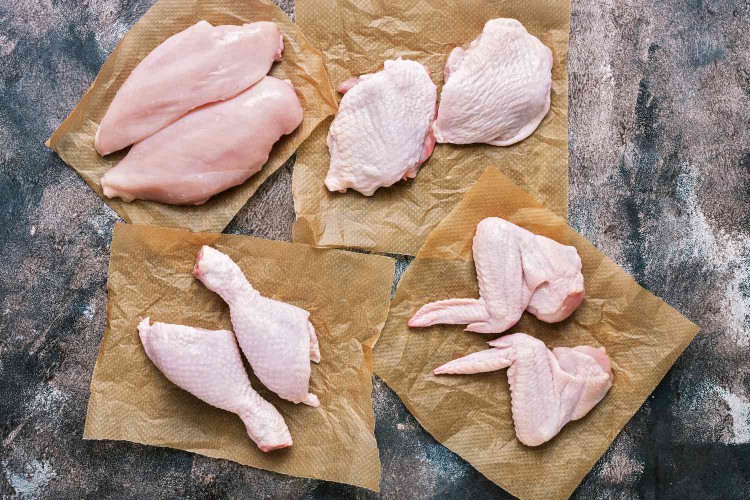
- Washing chicken before cooking is an unnecessary practice, according to health authorities.
- Instead of ridding the poultry of bacteria, washing chicken only increases the risk of food poisoning and cross-contamination.
- Experts recommend people practice proper food safety precautions, including thawing chicken in the fridge, avoiding cross-contamination on kitchen surfaces like cutting boards, and thoroughly cooking chicken to at least 165 degrees Fahrenheit.
Do you wash chicken before cooking it? Should you?
On TikTok, Reddit, and X, some people advocate for rinsing chicken in water, saying it helps remove harmful bacteria that may be on the meat.
However, health agencies say the practice doesn't accomplish anything.
According to the Centers for Disease Control and Prevention (CDC), washing chicken is unnecessary.
Not only does chicken not need to be washed, but doing so may cause more harm than good, Darin Detwiler, PhD, author, consultant, and professor of food policy at the Northeastern University College of Professional Studies, told Health.
“Cleaning a bird? All you’re doing is cross-contaminating the rest of your kitchen with pathogens,” he said. “You’re not actually doing anything that adds food safety value.”
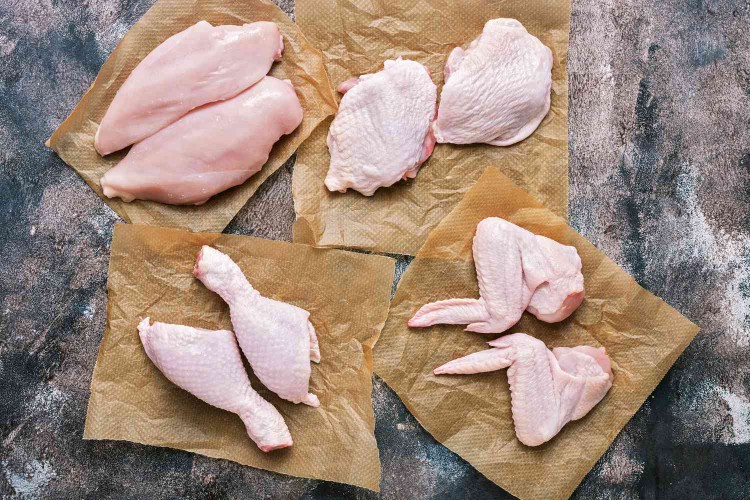
Yulia Gusterina/Getty Images
Cooking Raw Chicken Is the Safest Way to Avoid Foodborne Illness
Just because you don't need to wash your chicken doesn't mean you can throw out food safety precautions.
The CDC estimates that about a million Americans get sick each year from contaminated poultry; Salmonella is the biggest concern when it comes to these foodborne illnesses.
About 1 in 25 packages of chicken is contaminated with Salmonella, according to CDC estimates.
Though not all of these illnesses can be attributed to chicken, Salmonella causes about 1.35 million infections, 26,500 hospitalizations, and 420 deaths in the U.S. annually—more than any other bacteria.
An infection from Salmonella can cause four to seven days of diarrhea, fever, and stomach pain. But in rare cases, the bacteria can travel to other parts of the body, such as the blood, joints, or brain, and cause severe disease.
While it's understandable why people would want to take precautionary measures—like washing chicken—to avoid Salmonella poisoning, rinsing off chicken won’t kill any pathogens, Detwiler said.
“Usually people think that they can wash off bacteria, but it’s much safer to just cook it off,” Ciara Lundy, RDN, inpatient clinical dietitian at Mayo Clinic in Arizona, told Health. “If they cook their chicken to 165 [degrees], then that should kill all the bacteria.”
Cantaloupe Recalled in 19 States Over Possible Salmonella Contamination
Rinsing Chicken Actually Increases Your Risk of Food Poisoning
Researchers have shown that washing chicken “spreads pathogens all over your sink and around the faucet and the handle and the sides,” Detwiler explained.
In a U.S. Department of Agriculture observational study, participants were asked to prepare raw poultry and a garden salad. Researchers found that 60% of those who decided to wash their chicken had bacteria in their sinks. And 26% of those who washed their poultry ended up causing cross contamination: Bacteria from the poultry found its way onto their lettuce.
“It causes more problems than it solves,” said Detwiler.
The idea of washing chicken seems to stem from cooking methods that people learned from parents or grandparents, Detwiler explained.
A small 2021 survey found this to be true—participants said their “chicken preparation methods were primarily influenced by family.”
Detwiler explained that generations ago, it was necessary to wash chicken before it was prepared, since people were more frequently slaughtering or plucking their own chickens.
However, in our modern day, this has become largely obsolete.
“We’re buying birds that have been, if you will, manufactured and packaged,” said Detwiler. “In terms of the bird that we buy for cooking, it is prepared and packaged for us to be able to literally remove it from the bag and put it into the oven.”
Another possibility is people simply do it out of habit, Lundy explained, lumping raw poultry in with other grocery store ingredients that are usually washed.
“With produce and things like that, you want to wash those so that they’re clean. I think maybe [chicken] just kind of fell into the same category,” she said. “[With fruit or vegetables] you’re definitely going to wash that, because you can wash off dirt and grime and things like that. But no, you can’t wash the bacteria off.”
Signs and Symptoms of Food Poisoning
Other Tips to Stay Safe When Cooking Chicken
Beyond not rinsing chicken, there are other steps people can take to lower their risk of getting poultry food poisoning.
Right after the purchase of raw chicken, people should decide if they want to cook it within the next couple of days (in which case it can stay in the refrigerator), or if they’re going to eat it later in the week, Lundy explained. In that case, it should go in the freezer.
When thawing chicken, it shouldn’t be left out on the counter for long periods. And, it shouldn’t be cooked while frozen, Detwiler explained.
When thawing frozen chicken, Lundy explained that it’s best to avoid running it under cold water to speed up the process.
“You want to avoid the danger zone—40 degrees through 140 degrees—where pathogens grow the most,” he said. “Defrosting in the refrigerator over multiple days is preferred.”
The CDC also recommends that people bag their chicken when grocery shopping so that any juices don’t leak onto other foods. For the same reason, people should be sure their chicken is stored in a secure container, or stored at the bottom of their refrigerators.
During the cooking process, raw chicken should be kept on a separate cutting board so that it doesn’t come into contact with other foods, and any kitchenware that touches raw chicken should be washed with soap and hot water.
After cooking, chicken (or other poultry) is good in the refrigerator for three to four days, Detweiler said. It should be kept in the freezer if people are hoping to eat it any later than that.
If someone has gotten in the habit of washing their chicken or wants to continue doing so, the CDC recommends doing it as safely as possible.
This means gently running water over the chicken to lower the risk of splashing, cleaning the sink and surrounding areas immediately afterward, and practicing proper hand washing.
Though these steps may be a bit more tedious, they can go a long way in helping people stay healthy.
“We don’t want to undo all the great work that’s gone into food safety,” said Detwiler. “The consumer does need to play some role in terms of making sure that food is safe.”
Food Safety Experts Share 18 Things They’d Never Do In Their Own Kitchens